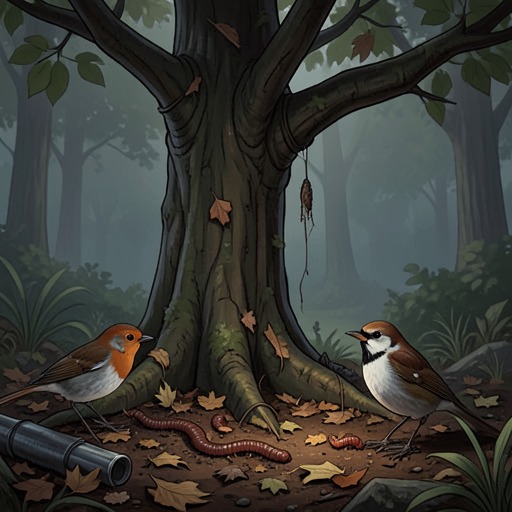
DDT–earthworm–robin poisoning cycle
Silent SpringThe DDT–earthworm–robin poisoning cycle is the chain by which spraying elm trees with DDT contaminated leaf litter, earthworms accumulated the chemical while feeding, and robins received it through their diet. Its significance lies in making an indirect consequence visible: robins did not have to be sprayed themselves for the poison to reach them, and the damage extended from deaths to impaired reproduction.
From Elm Trees to Leaf Litter
In spring, elms were sprayed against the bark beetle, sometimes at a rate of two to five pounds of DDT per fifty-foot tree. Where elms were numerous, this could amount to as much as twenty-three pounds per acre. Spraying could be repeated in July at about half the concentration. Powerful equipment directed poison into the trees, killing not only the target beetle but also other insects, including pollinators and predatory spiders and beetles. The DDT formed a persistent film on leaves and bark that rain did not wash away. In autumn, the leaves fell and accumulated in damp layers on the ground, where they began to decompose and join the soil. The chemical thus remained in the habitat after the spraying season ended, carried from the treated canopy into the litter where earthworms fed.
Earthworms as the Link
Earthworms favored elm leaves and swallowed the insecticide as they consumed them. Roy Barker’s research, published in 1958, traced DDT deposits throughout the worms’ digestive tracts, blood vessels, nerves, and body walls. Some worms died, but others survived while accumulating and concentrating the poison in their bodies. They became a route by which the chemical moved from treated vegetation into the food supply of animals feeding on the ground. Evidence of poisoning among campus animals supported concern about this indirect pathway. Earthworms from the campus had inadvertently been fed to crayfish in a research project, and the crayfish died. The observation did not by itself establish the entire sequence, but it strengthened the suspicion that the robins’ exposure came not mainly from direct contact with insecticide, but from eating contaminated worms.
Robins and the Consequences
Robins returned in spring and supplied the next link in the cycle. As few as eleven large earthworms could transfer a lethal dose of DDT to a robin; eleven worms represented only a small part of the daily ration of a bird that could eat ten to twelve worms in as many minutes. The feeding behavior that normally sustained the birds made the contaminated soil a route of exposure. Not every robin received a lethal dose, so the cycle’s effects were not limited to birds found dead. The account also connects the poisoning to reproductive failure: the death of one or both members of a pair could interrupt nesting, while observations pointed to a more serious possibility—the destruction of the birds’ capacity to reproduce. On the main campus, no fledgling robin was seen during the summer of 1958 by the observer cited in the book, who also reported finding no one else who had seen one there.
Ecological Meaning
The sequence is an example of food-chain transfer and biological magnification: a chemical applied to trees persisted in fallen leaves, entered earthworms, and reached birds through ordinary feeding. Each step carried the consequences of the original spraying beyond its intended target and into another part of the community. The book returns to the elm-leaf–earthworm–robin cycle as a matter of record and as a compact illustration of ecological connection. In its account, the following springs could be silent of robin song not because the birds had been sprayed directly, but because poison had moved step by step through the food chain. The cycle gives concrete form to the larger argument that an intervention aimed at one pest can travel through an interconnected environment and harm organisms never named as its targets.